Windows · Doors · Siding · Roofing
Everything an exterior renovation company runs on. One system.
The presentation your rep runs at the kitchen table. The pipeline it feeds. The marketing that fires off that pipeline. The job costing underneath that tells you whether you actually made money. Outerframe is all of it, on one data layer — not four tools that export to each other.
Why one system
The money leaks in the gaps between your tools.
A presentation tool that can't see your cost basis. A CRM that doesn't know what was measured. A spreadsheet holding the price book. A lender portal in a separate tab. Every one of them is fine at its own job, and every handoff between them is a place a number gets retyped, a follow-up dies, or a margin quietly disappears.
Outerframe is one spine. The unit your rep configures at the kitchen table is the same record that prices the job, triggers the drip sequence, orders the material, bills the customer and lands in the ledger. Nothing is re-keyed, because there is nowhere to re-key it to.
What's in it
Six systems, one platform.
Every screen below exists and runs. Nothing here is a roadmap item.
In-home sales
A guided appointment your reps run the same way every time. Five trade configurators, aerial measurement, Good/Better/Best off one takeoff, a seven-lender financing cascade, and signature at the table.
See itCRM & pipeline
Twelve stages from lead to closed, with dollars at every one. Cards that flag themselves when a job goes quiet or a proposal runs hot. A migration engine that gets you off whatever you're running today.
See itMarketing engine
Thirteen drip sequences that fire off pipeline events rather than an exported list — speed-to-lead, unsigned-proposal nudges, missed-call text-back, and reactivation of quotes that died years ago.
See itProduction & procurement
Jobs moving through order, materials, schedule, install and punch list. Purchase orders against the takeoff, and a vendor-payment queue with banking-change fraud controls built in.
See itJob money
True margin per job with the financing dealer fee subtracted. Billing that happens by itself, burdened crew labour, and a WIP schedule built on a double-entry journal that checks its own books.
See itCommand & control
A morning brief that says why a number moved. Internal messaging where the job speaks in its own room. Five roles, 43 permissions, and an audit log that records the refusals as well as the approvals.
See itThe part that closes jobs
Your best rep's appointment, run by everyone.
The presentation is generated from the job — the roof the configurator measured, priced off your book. The thing on the iPad and the thing on the contract are never two different documents.
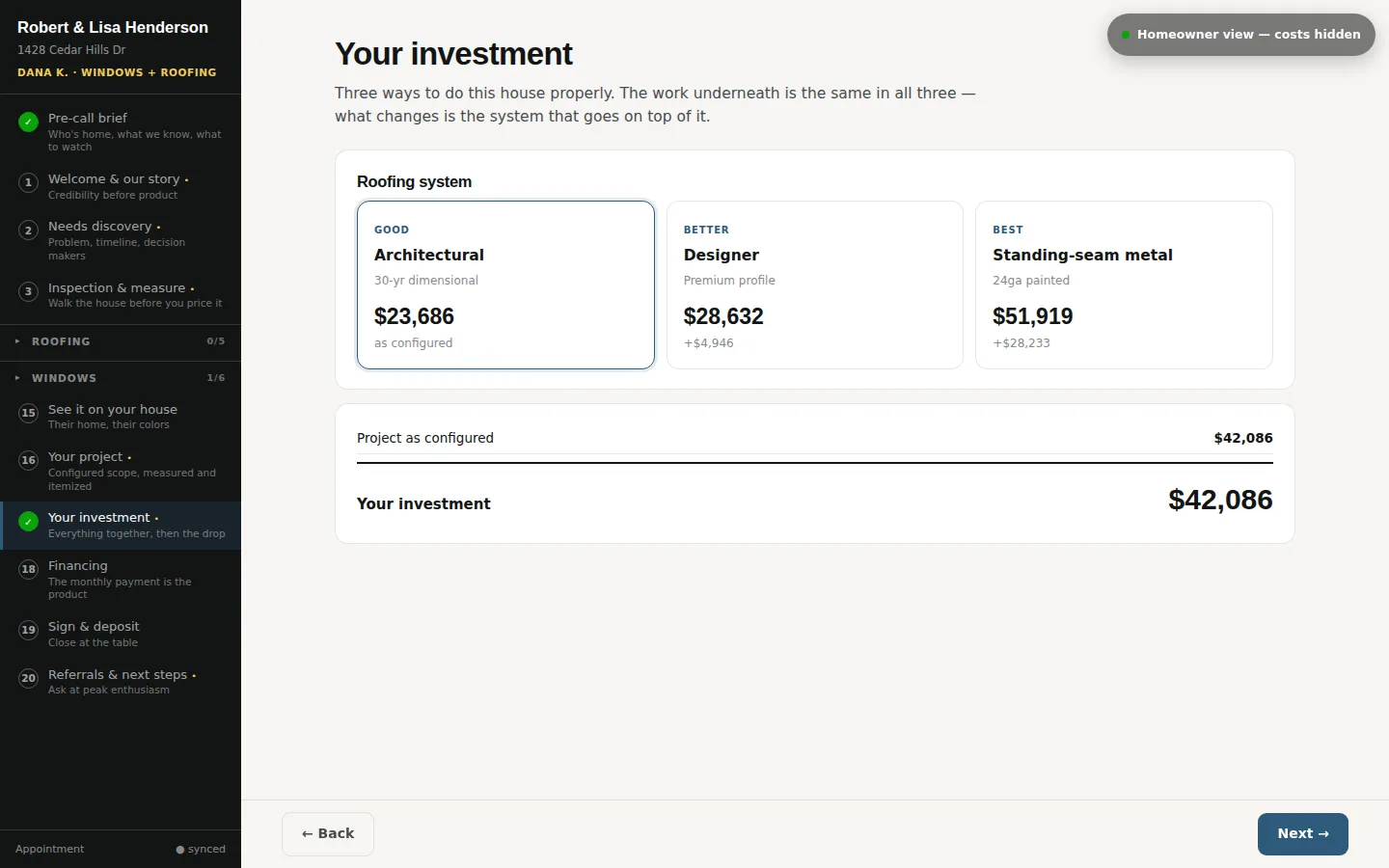
Turn the screen around and every cost disappears.
- One toggle strips every cost, margin and dealer-fee figure — on the server, not hidden in CSS. A homeowner leaning over reads nothing you wouldn't hand them.
- Good, Better and Best re-cost from one takeoff, so the tiers can't drift apart mid-pitch.
- The product story is authored once and presented the same way in every kitchen, with manufacturer facts locked against edits.
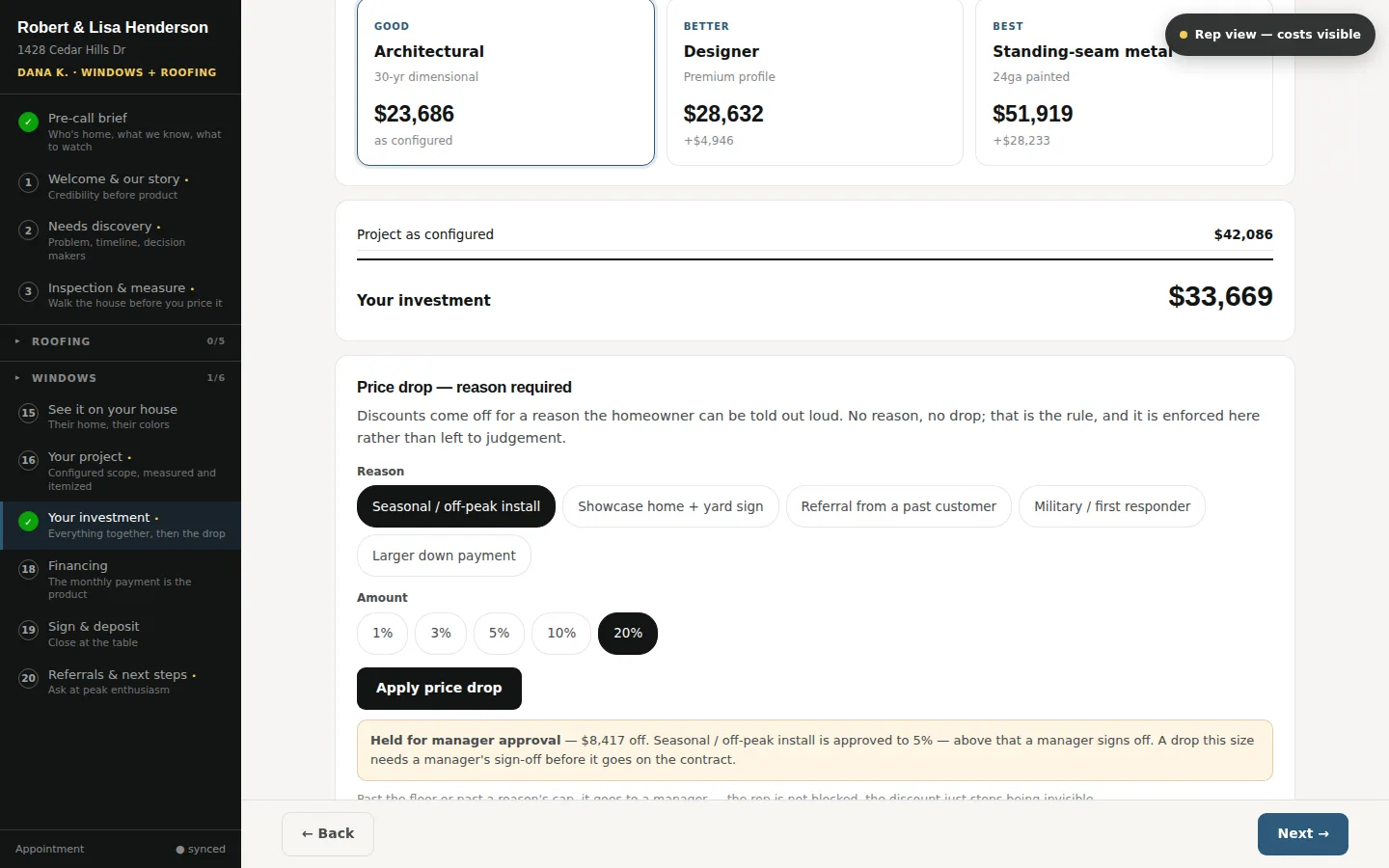
A discount your margin can't afford gets held, not applied.
- The system refuses it by arithmetic, not policy — it knows what the job costs, so it knows what the drop leaves.
- The reason is required and the cap is named on screen, so a discount is a decision rather than a habit.
- Approval routes to the people who can see cost, and the answer comes back with the money off and no margin attached.
The number most contractors never see
Your finance program costs more margin than any discount you'd allow a rep to offer.
Financed jobs carry a lender dealer fee. It comes off the job, not off a line item anyone looks at — so it never reaches the number you use to judge the work. In the demo's book that gap is four points of gross margin and $8,924 gone to lenders.
Presentation software can lock which discounts a rep may show. Only a system that owns both the cost basis and the loan can price the promo itself.
See the money sideWho it's for
Big enough to be disorganised.
There's a stage where the founder's memory stops scaling. That isn't a people problem, it's a systems gap — and it's the stage this platform is built for.
- $10M–$30M in revenue, 30–100 employees, exterior renovation — windows, doors, siding, roofing.
- A sales manager with 6–12 reps, crews in-house or sub, an office manager, and nobody who owns "systems."
- A CRM you're invested in but frustrated by — real gaps, and no way to get what you need built. Or no CRM at all.
- Deal sizes of $50K–$100K, where a one-point move in close rate pays for the year.
Who built it
Two of the three founders run exterior renovation companies.
This wasn't built by a software team who interviewed some contractors. It was built by a 35-year window and door man, alongside the owners of a window and door company and a roofing company — people who have measured it, ordered it, watched it come in wrong, and installed it.
That's why the data model knows what a mullion is, why the configurator is built on real manufacturer price books, and why the rep's screen assumes a homeowner is reading over their shoulder.
About OuterframeWatch it run before you talk to anyone.
The demo is the real platform, loaded with a fictional $15M contractor's data. No form, no video — real screens, in the order they happen.