Features · Job money
Did we actually make money on that job?
Every owner asks it. Most systems answer with a guess, because they can see what was invoiced and not what it cost. Revenue is what you sold — this is the part that tells you what you kept.
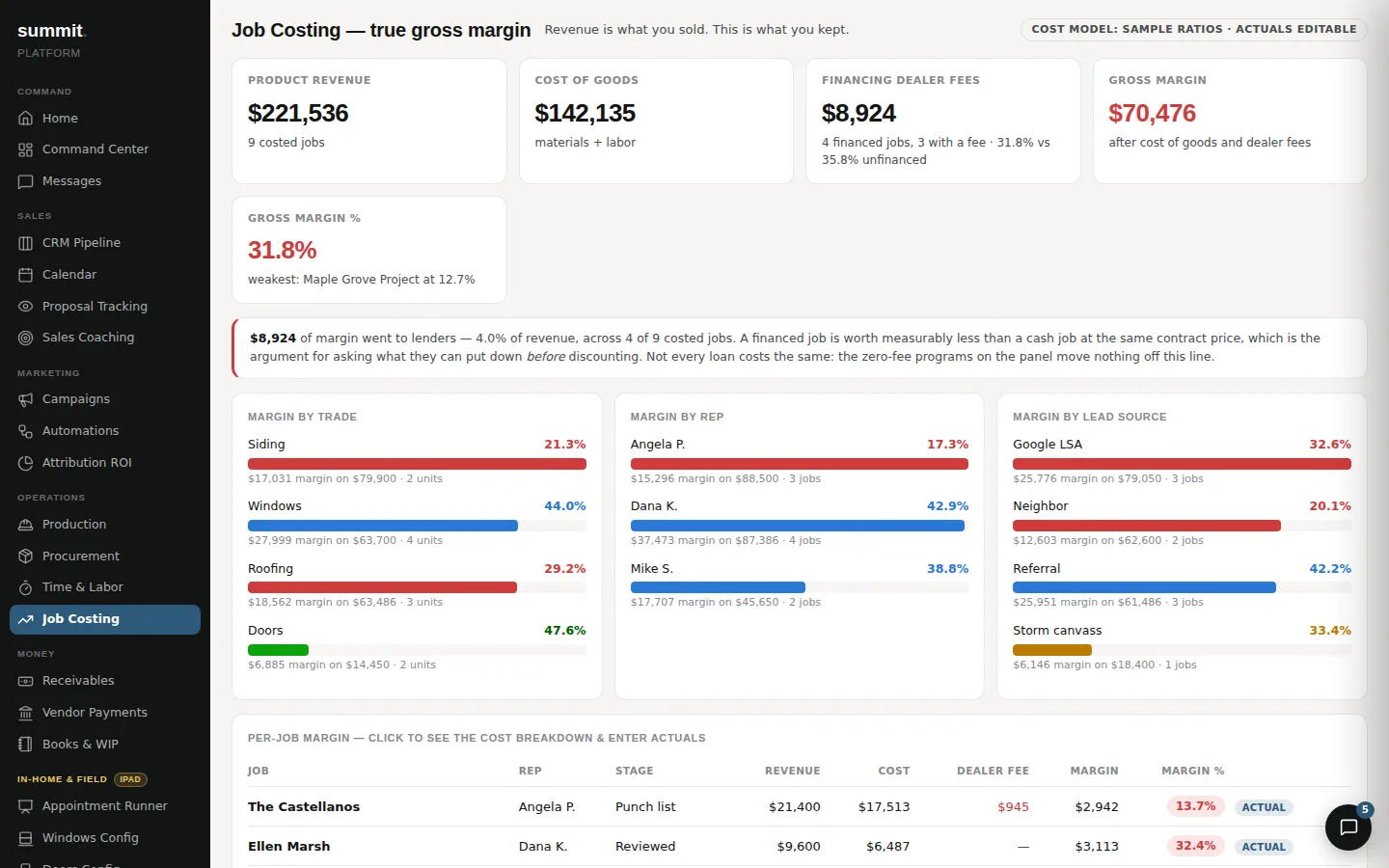
True margin
Cost that traces back to the takeoff.
- Materials from matched vendor bills, not an estimate somebody typed in at the end of the month.
- Labour at a burdened rate — approved crew hours loaded with payroll tax, workers' comp and liability.
- The financing dealer fee subtracted, which almost nothing else in this trade puts on the job.
- Margin by trade, by rep and by lead source, so a thin channel or a rep discounting their way to quota shows up as a number.
The cost nobody puts on the job
A 0% promo can cost more margin than any discount you'd approve.
Financed jobs carry a lender dealer fee — often eight to eleven percent of the contract. It comes off your money, but it lands nowhere a person looks, so it never reaches the number used to judge the job or the rep who sold it.
Because the platform owns both the cost basis and the loan, it can price the finance program itself: the margin floor knows that a zero-interest offer is the most expensive thing on the panel.
Four points, and $8,924 gone to lenders on the demo's book. To stay margin-whole, the system tells the rep exactly what to price the job up by — or which lower-fee program still lands the payment the homeowner wanted.
Getting paid
Billing that happens by itself.
Signing lays out the payment schedule. Reaching a stage issues the invoice. Nobody has to remember that the Hendersons owe a materials draw.
- Deposits are held through the right-of-rescission window — trying to send one early is refused with the release date, because a homeowner who can still legally cancel has not paid you yet.
- Aging and collections ride the same drip engine as the rest of the marketing, so a late invoice chases itself.
- Deposit reconciliation against what was actually agreed at the kitchen table.
- Writing a debt off is a manager's call — the person chasing the money is deliberately not the person who can decide it's gone.
The books
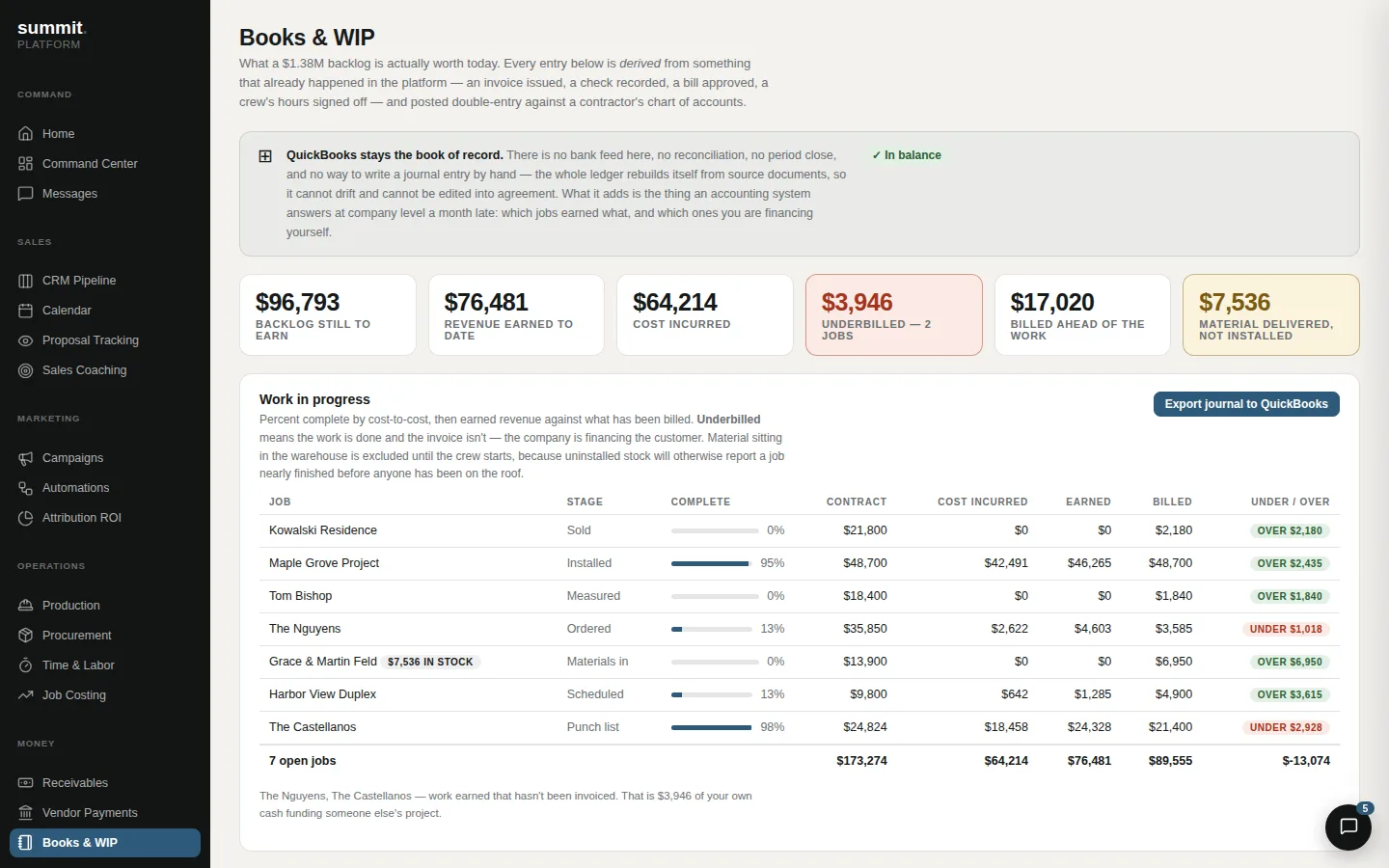
What a $1.38M backlog is actually worth today.
- Percent complete, earned revenue against billed, and the underbilled column — the jobs you're financing out of your own cash.
- Every figure derives from a double-entry journal built out of invoices, receipts, approved vendor bills and approved crew hours.
- The screen checks its own books and tells you when they don't balance, which a spreadsheet cannot do.
- Backlog in weeks, not just dollars — too thin is a revenue cliff, too fat is angry customers.
Money out
The way contractors actually lose money.
A spoofed supply house emails accounts payable with new banking details, and the next $40,000 material payment lands in a stranger's account. It is the most common large-dollar loss in this trade and it is entirely preventable.
- Banking details can't be edited — only changed by request, scored for risk, and held while pending.
- Verification calls the number already on file, never the one in the email.
- The person who submits a change can't approve it. One compromised mailbox and one helpful employee shouldn't be enough to move funds.
- Purchase orders build from the takeoff, so what you ordered matches what you sold and a bill that doesn't match gets caught.
See it against a real book of business.
Nine costed jobs, four of them financed, a backlog with an underbilled column, and a ledger that balances — in the demo, with the arithmetic showing.