Features · Pipeline & marketing
Marketing that runs off the pipeline, not off a list.
Every follow-up system in this trade dies the same way: it depends on somebody remembering to export, upload and remember again next month. Here, moving a card is the trigger. There's no list to maintain because there's no list.
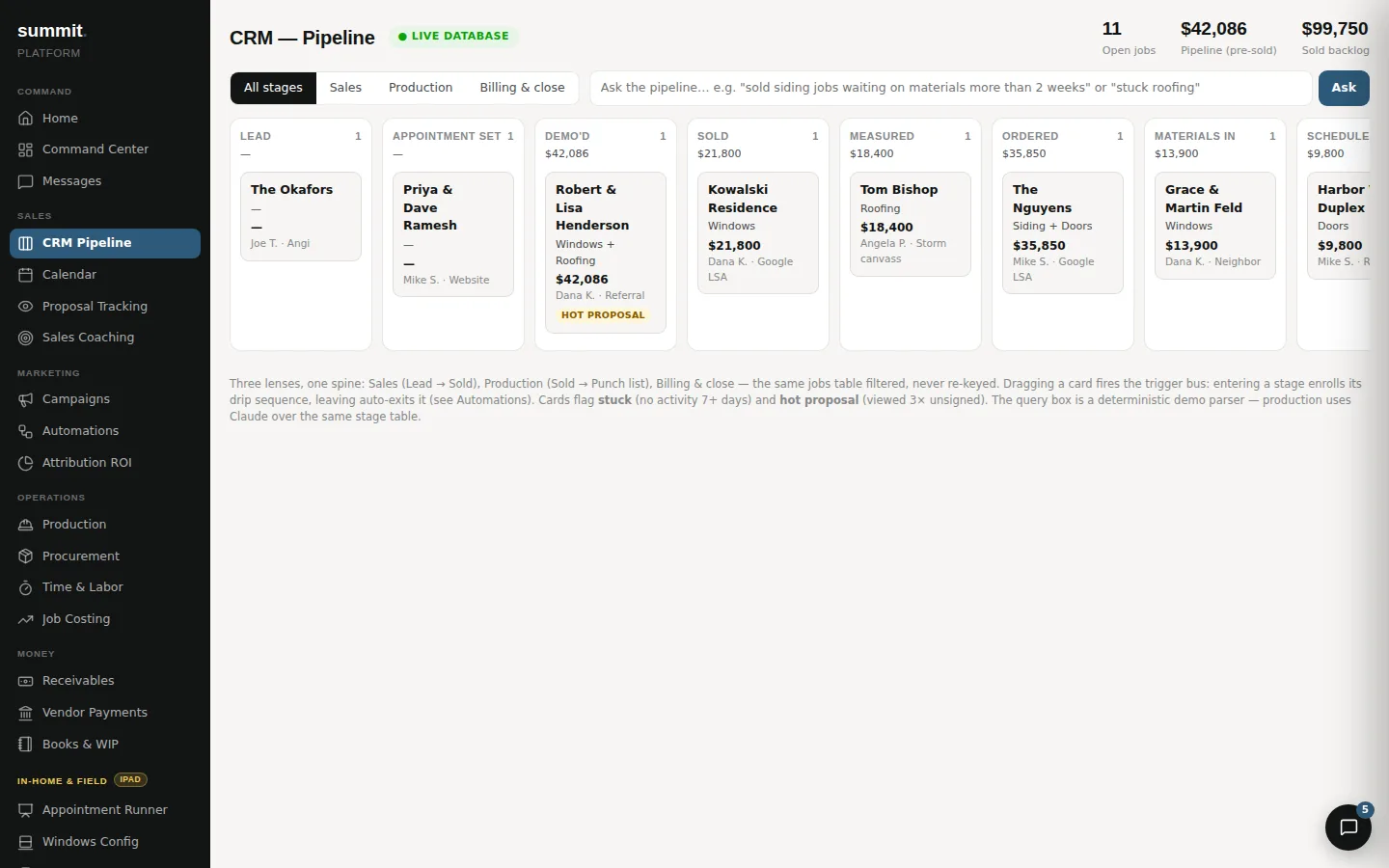
The board
Twelve stages, and you can just ask it.
- Dollars at every stage, so "how much is in the pipeline" isn't a monthly exercise in adding things up.
- Ask in plain English — "sold siding jobs waiting on materials more than two weeks" — because the person who needs that at 7am shouldn't have to build a report.
- Cards flag themselves: stuck after seven quiet days, hot when a proposal is opened three times without a signature.
- Three lenses over the same jobs — sales, production, billing. The office and the field are never reading different copies.
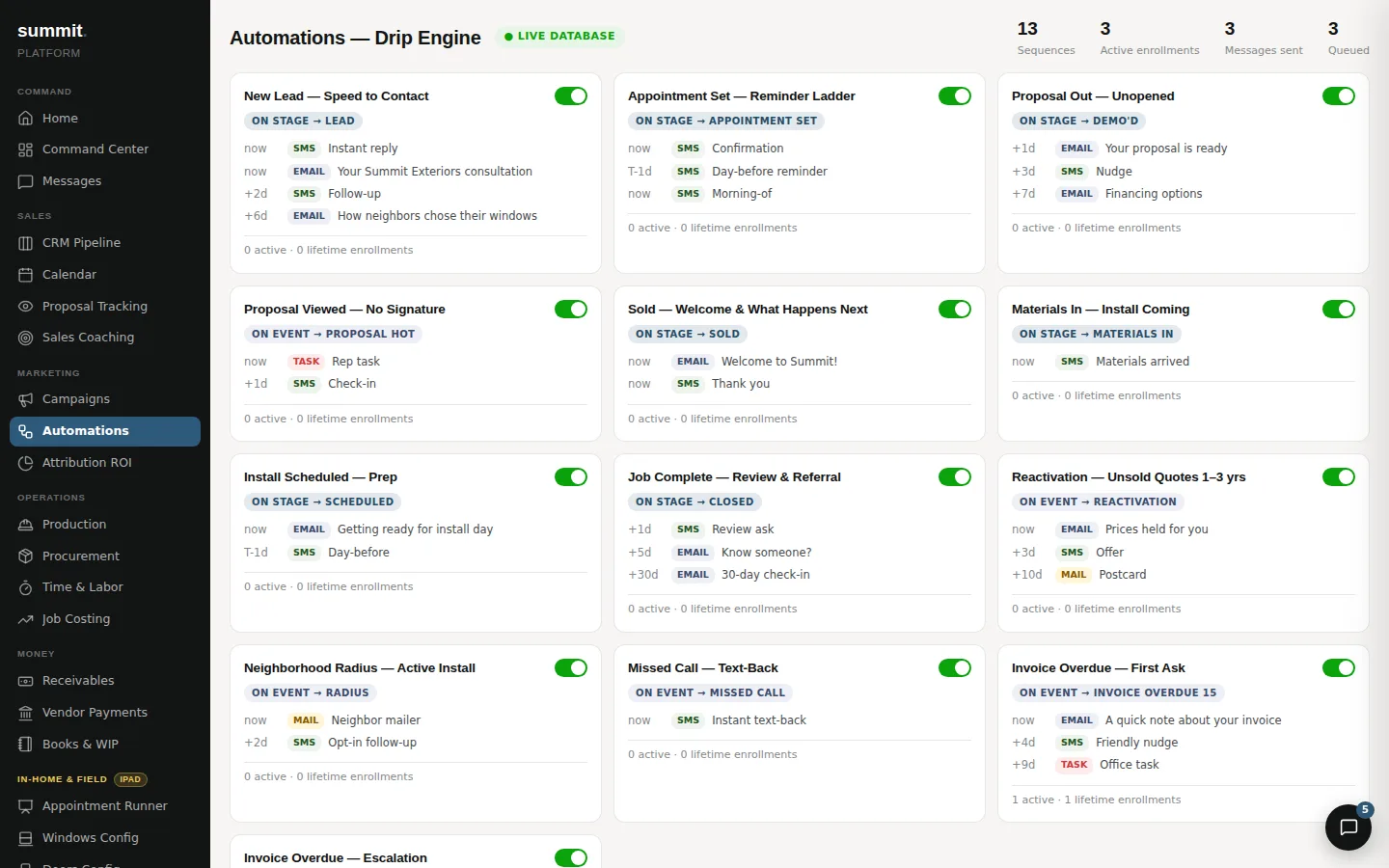
The drip engine
Thirteen sequences, tied to what actually happened.
Entering a stage enrolls a job in its sequence. Leaving auto-exits it. Nobody unsubscribes a customer by hand and nobody gets a "still thinking it over?" email the day after they signed.
- Speed to contact: an instant reply the moment a lead lands, then a laddered follow-up — because the first company to call back usually wins.
- Appointment reminders the day before and the morning of, which is the cheapest no-show reduction available.
- Proposal out, unopened → nudge. Opened three times, unsigned → wake the rep with a task.
- After install: the review ask at peak enthusiasm, then the referral ask, then a 30-day check-in.
The three that pay for themselves
Money you already spent, going to waste.
Reactivation
Quotes that died one to three years ago, worked automatically — email, then an offer, then a physical postcard. The cheapest appointment you can book is one you already paid a lead source for, and most companies never touch them again.
Missed-call text-back
A call you couldn't answer texts back by itself, immediately. In a trade where the homeowner is calling three companies from a search result, this is the difference between a lead and a competitor's lead.
Neighbourhood radius
An active install triggers a mailer to the street around it. The truck is already there, the roof is already visible, and the neighbours are already asking — the only missing piece was somebody pulling the list.
Attribution
Which lead sources make money, not which make leads.
Every lead carries its source through to the closed job and the margin on it. So the question stops being "how many leads did Google send" and becomes "what did those jobs actually earn compared to the referrals."
- Margin by lead source, not just volume — a channel that delivers cheap leads on thin jobs is a channel that costs money.
- Cost per booked appointment and per sold job, per source.
- Referrals measured like a channel, because in this trade they're usually the highest-margin one and nobody manages them.
Customer texting is specified and partially built — one company number, a thread per job, and consent kept as an append-only ledger rather than a checkbox, because "prove they agreed" is a question that arrives eighteen months later. The demo badges what sends and what doesn't.
See the board and the engine wired together.
The tour walks the pipeline, the sequences firing off it, and the coaching grid that shows whether any of it turned into closed jobs.